
You are paying for machine time
Most people want one number for footers. We get it. But the honest answer is that footer digging is priced by how long the machine runs, and that depends on your site and your plans.
Two houses with the same square footage can take very different amounts of time to dig. One sits on flat, open ground with soft dirt. The other sits on a slope with rock two feet down and one narrow way in. The footprint is the same. The work is not.
That is why we do not put a whole-job price on this page. Any number we gave you without seeing the lot would be a guess, and a guess helps nobody.
Our hourly rates
These are our real starting rates, per machine, per hour. The final price depends on the job and what we see on the site visit.
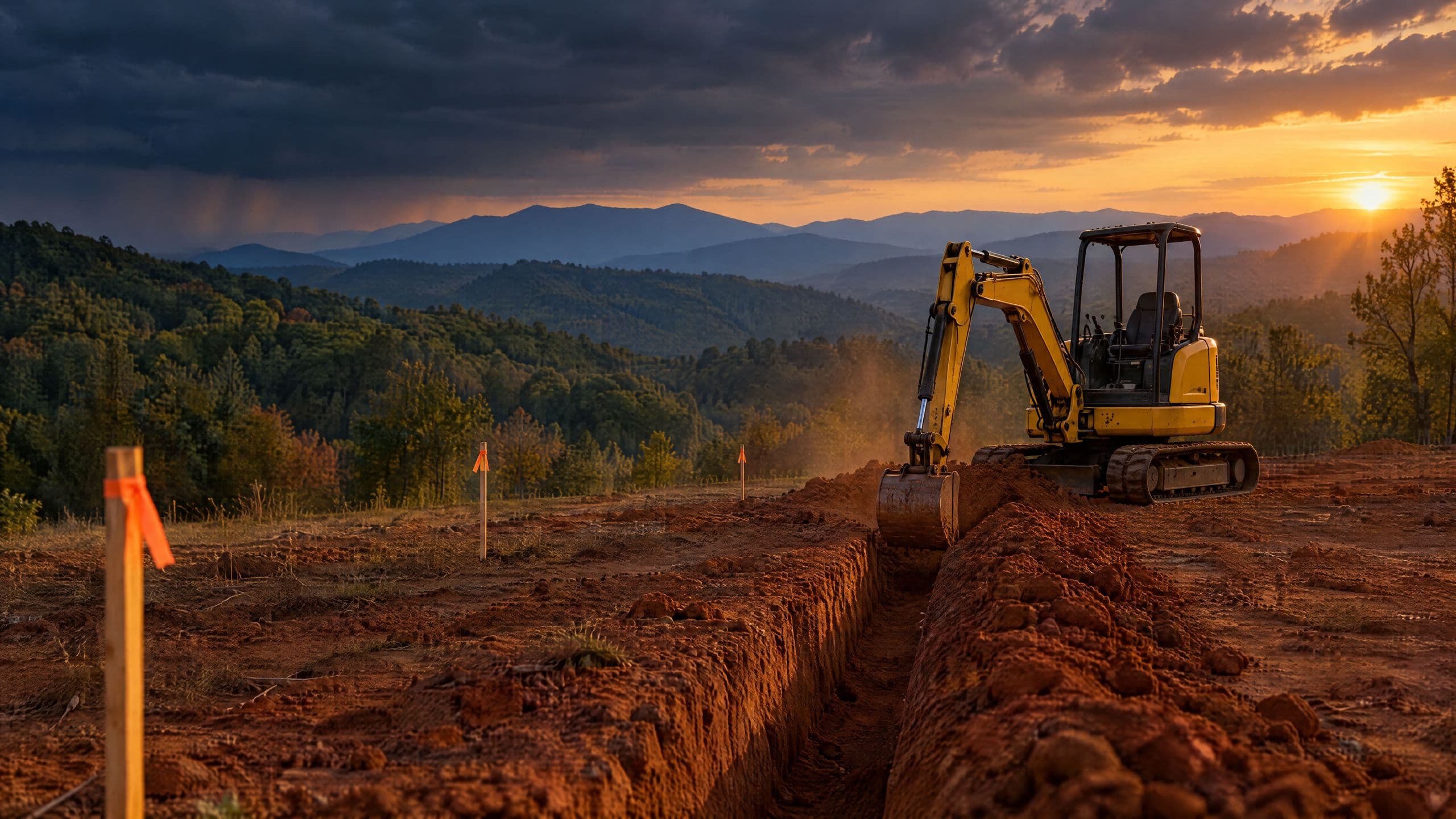
- Caterpillar 305 mini excavator: starting at $135 an hour. This is the main machine for digging footers. It digs clean, square trenches to depth and fits on tight lots.
- Caterpillar 265 skid steer: starting at $125 an hour. Used to clear and level the pad, move spoil and clean up around the dig.
- Vermeer mini skid steer: $85 an hour. With 10 inch and 24 inch augers and a trencher, it handles piers, post holes and narrow trenches in tight spots.
What changes the time
These are the things that make a footer job go faster or slower. Most of them you can see on the lot or on the plans.
- Size and shape of the footprint. More linear feet of footer means more digging. A simple rectangle is quicker than a footprint with lots of corners, jogs, porches and bump-outs.
- Depth on the plans. Deeper footers mean more dirt out of every foot of trench. We dig to the depth your plans and your builder call for.
- Rock. East Tennessee has a lot of it, and it often shows up where you least want it. Rock near the surface slows the dig down. We cannot see it from the road, and sometimes not until the bucket finds it.
- Slope. On a sloped lot the footer often has to step down the hill. Steps take more care and more time than one level run.
- Access. A wide, firm path for the machines is quick. A narrow gap between trees, a soft yard or a lot with no room to turn around adds time.
- Wet clay. Our red clay is fine to dig when it is dry. When it is soaked it gets heavy and sticky, the machines slide, and the trench walls want to slump. Sometimes the right call is to wait a few dry days.
- Room for the spoil pile. Every bit of dirt that comes out of the trench has to go somewhere. If there is room on the lot, it goes close by. If there is not, it has to be moved farther, and that takes machine time.
Why we walk the site first
We come out and walk the property with you before we give you a number. No guessing from a photo.
On the walk we look at the plans and the stakes or lines, how the ground lays, how we get the machines in, where the spoil can go and whether there are signs of rock or wet ground. We also ask where your private lines are, like a water line to a shed or a line to a well.
After that, you get a straight number for the job, in writing, before we start. If something on the site is a question mark, like rock we cannot see yet, we tell you up front how we will handle it.
How to keep the time down
A few things on your end make the dig go smoother.
- Have the plans ready and the footprint staked or marked before we show up.
- Call Tennessee 811 at least three working days before digging so public lines get marked.
- Clear a path for the machines. Move vehicles, trailers and materials out of the way.
- Tell us where the dirt can go, or if it has to stay off part of the lot.
- If the ground is soaked, ask us whether a short wait makes sense.
Getting a number for your footers
Call us at (865) 346-6688 or send the quote form. Tell us where the lot is, what you are building and whether you have plans. We serve Knox, Blount, Loudon, Sevier, Anderson and Roane counties.
We will set a time to walk the site, then give you a straight number in writing. Our own crew shows up with our own equipment to do the work.